Harte
Well-Known Member
- Joined
- Apr 16, 2017
- Messages
- 730
This is an article I wrote about 15 years ago. Since that time, I've learned quite a bit more about the Sphinx. I'll not put in any addenda to this article though. I just wanted to put something in this section.
It's likely that some of the links I provided are dead by now. If anyone asks, maybe I'll update them later.
A few years back, around 1990, at the request of John Anthony West (the infamous self-taught Egyptologist, tour guide, and proponent of Atlantean-like ancient civilizations), Dr. Robert Schoch, Geophysicist and professor at Boston University conducted a geological survey of the sphinx and the sphinx enclosure at Giza in Egypt, with an eye toward estimating the age of the sphinx based on patterns of erosion West had pointed out to him.
Now, Schoch is not exactly Erik VonDaniken. He has no axe to grind, prior to this survey he was not a famous proponent of pseudoarchaeology, he’s just a geologist. Sure, he might be led into mistaken ideas, like many scientists are when they venture outside their field - Einstein was fascinated by the preposterous idea that the entire crust of the Earth could shift around in one quick movement, like the loosened skin on an orange, Linus Pauling advocated massive doses of vitamin C as a cure-all for everything, etc, etc…. What I’m getting at is that, though West had placed this sphinx antiquity idea into Schoch’s head prior to the survey, the fact that geology was involved, and thus Schoch’s reputation, possibly even his livelihood, is enough to indicate to me that his findings represent his honest attempt to estimate the age of the sphinx based on erosion.
What Schoch found was that the erosion on the enclosure wall of the sphinx appeared to be due to water, probably runoff of rainwater from centuries of storms. Using sonar-type technology to examine the limestone floor of the sphinx enclosure (which is covered with sand, and has been for a very, very long time), Schoch also determined that the floor of the sphinx enclosure had weathered significantly on the eastern (front) floor, when compared to the western floor. This sort of weathering, which is caused by exposure to the air (not by rain) and would not be prevented by the sand covering – no matter how deep - has been used extensively by geologists in the past to estimate dates of exposure of rock. It is the relative differences in this kind of weathering that is useful in these cases. Schoch, knowing that the common view was that the sphinx was carved by order of Kaphre around 2500 BC, took the rear portion of the enclosure floor to be of this age. Calculations based on the more extensive weathering in the floor at the front of the enclosure led Schoch to estimate that this portion of the enclosure had to be at least 2000 years older, and possibly 5000 years older, or more. The “or more” part is based mainly on the fact that such weathering is usually not linear.
The weathered limestone of the floor is still there; it’s not washed away or anything. The deeper the weathering extends, the slower future weathering proceeds. Since this relationship between time and depth of weathered rock is nonlinear, good estimates of the actual date of first exposure are very difficult to arrive at. You see, different limestones will weather at different rates, even layers within the same deposit of limestone differ greatly in their properties. Because of this, Schoch is comfortable with a date of at the latest 4750 BC for the first exposure of the floor of the sphinx enclosure on the eastern (front) side. And the uncertainty in the dating is what allows this portion of the enclosure to be “possibly” dated to 7000BC or even earlier. This time period corresponds well with a wet period at Giza that could account for the apparent rainwater runoff type of weathering that can be seen on the enclosure walls and on the sphinx body itself. The most recent wet period that we know of at Giza when there was rain enough to account for this observed water erosion on the sphinx enclosure wall was during what’s called the Neolithic Wet Phase. The height of this wet period was around 6,000 BC.
Climatology at Giza is fairly well known. The Egyptians kept fairly good records; they were an agrarian society, after all. Heavy rainfall was never more than sporadic during the ancient Egyptian civilization. The big thing for the Egyptians was the annual Nile flood. It goes almost without saying that they didn’t know where these floods came from. I mean, the entire flood thing was part of their religion, and they made no connection to any rainfall causing it. In fact, the Nile flooding, which still occurs today, is due to heavy seasonal rains far upstream from Egypt. So if the erosion on the wall of the enclosure is due to water, it’s unlikely to be from rainfall in the modern or even Egyptian Dynastic era. The fact that the height of the Neolithic Wet Phase corresponds almost perfectly with Schoch’s calculations concerning the buried floor of the enclosure means one of two things. Either one piece of data reinforces the other, or Schoch had the Neolithic Wet Phase in mind and fudged his Sphinx enclosure floor data to match up with it. The former is the likelier, since the latter involves peer-reviewed scientific data interpretation.
Other arguments for sphinx antiquity stem from the uncomfortable fact that, though it’s construction is attributed to Kaphre, and the face of the sphinx is supposed to be Kaphre’s face; there exist no records from Kaphre’s reign that would indicate that he decreed that it should be built. Additionally, forensic comparisons of the face of the sphinx with what we know of Kaphre’s face show that the two faces just don’t match up. To my mind, the former argument is a better one than the latter, after all, we have no good statues of Kaphre (just one small carving – about 8 inches tall, that is believed to certainly be Kaphre, and it’s a full length body image making the face small indeed, and another carved bust that we believe might be Kaphre.) Also, exactly how precise do we require an artist to be when carving the Pharaoh’s face? I would think that there would be room for artistic license, especially if the Pharaoh was in fact not a handsome man.
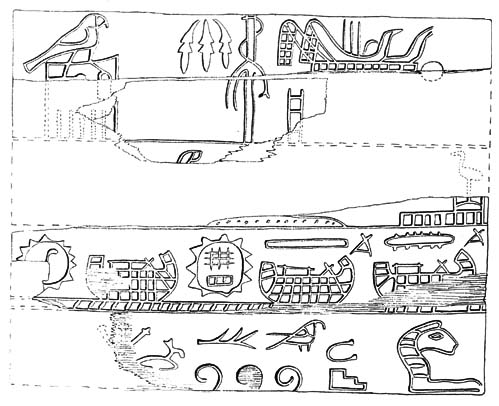
Other arguments for the sphinx’s ancientness are somewhat less convincing. One I recently learned of involves predynastic ivory labels with a sphinx portrait painted on them. First a word about these labels.
In the late predynastic period, between 3500 and 3100 BC, Egyptians began using little carved or painted labels with pictures of animals, plants, mountains, etc. on them to indicate the source of various payments of taxes to the regional leaders (this was before Egypt was united.) I believe the earliest of these has been found in or around Abydos, a settlement in what’s called “Upper Egypt,” meaning the southern part of Egypt (upstream on the Nile is why it’s called “upper”.) Anyway, these labels were used to keep track of which of the surrounding settlements, which were ruled by the leader and subject to his taxation, had paid their taxes, and what payment they had made. The pictograms on the labels stood for the various villages. These pictograms evolved into hieroglyphics, eventually.
The Egyptian “upper kingdom” was united around 3100 BC by an unknown Pharaoh possibly Narmer, maybe an unknown Pharaoh who is represented by a scorpion (yes, that’s where they got the movie from). The Egyptians of this time continued to use these labels, and the existence of any such label that could be convincingly shown to represent the actual sphinx monument would certainly prove that the sphinx was at least this old.
Continued next post
It's likely that some of the links I provided are dead by now. If anyone asks, maybe I'll update them later.
A few years back, around 1990, at the request of John Anthony West (the infamous self-taught Egyptologist, tour guide, and proponent of Atlantean-like ancient civilizations), Dr. Robert Schoch, Geophysicist and professor at Boston University conducted a geological survey of the sphinx and the sphinx enclosure at Giza in Egypt, with an eye toward estimating the age of the sphinx based on patterns of erosion West had pointed out to him.
Now, Schoch is not exactly Erik VonDaniken. He has no axe to grind, prior to this survey he was not a famous proponent of pseudoarchaeology, he’s just a geologist. Sure, he might be led into mistaken ideas, like many scientists are when they venture outside their field - Einstein was fascinated by the preposterous idea that the entire crust of the Earth could shift around in one quick movement, like the loosened skin on an orange, Linus Pauling advocated massive doses of vitamin C as a cure-all for everything, etc, etc…. What I’m getting at is that, though West had placed this sphinx antiquity idea into Schoch’s head prior to the survey, the fact that geology was involved, and thus Schoch’s reputation, possibly even his livelihood, is enough to indicate to me that his findings represent his honest attempt to estimate the age of the sphinx based on erosion.
What Schoch found was that the erosion on the enclosure wall of the sphinx appeared to be due to water, probably runoff of rainwater from centuries of storms. Using sonar-type technology to examine the limestone floor of the sphinx enclosure (which is covered with sand, and has been for a very, very long time), Schoch also determined that the floor of the sphinx enclosure had weathered significantly on the eastern (front) floor, when compared to the western floor. This sort of weathering, which is caused by exposure to the air (not by rain) and would not be prevented by the sand covering – no matter how deep - has been used extensively by geologists in the past to estimate dates of exposure of rock. It is the relative differences in this kind of weathering that is useful in these cases. Schoch, knowing that the common view was that the sphinx was carved by order of Kaphre around 2500 BC, took the rear portion of the enclosure floor to be of this age. Calculations based on the more extensive weathering in the floor at the front of the enclosure led Schoch to estimate that this portion of the enclosure had to be at least 2000 years older, and possibly 5000 years older, or more. The “or more” part is based mainly on the fact that such weathering is usually not linear.
The weathered limestone of the floor is still there; it’s not washed away or anything. The deeper the weathering extends, the slower future weathering proceeds. Since this relationship between time and depth of weathered rock is nonlinear, good estimates of the actual date of first exposure are very difficult to arrive at. You see, different limestones will weather at different rates, even layers within the same deposit of limestone differ greatly in their properties. Because of this, Schoch is comfortable with a date of at the latest 4750 BC for the first exposure of the floor of the sphinx enclosure on the eastern (front) side. And the uncertainty in the dating is what allows this portion of the enclosure to be “possibly” dated to 7000BC or even earlier. This time period corresponds well with a wet period at Giza that could account for the apparent rainwater runoff type of weathering that can be seen on the enclosure walls and on the sphinx body itself. The most recent wet period that we know of at Giza when there was rain enough to account for this observed water erosion on the sphinx enclosure wall was during what’s called the Neolithic Wet Phase. The height of this wet period was around 6,000 BC.
Climatology at Giza is fairly well known. The Egyptians kept fairly good records; they were an agrarian society, after all. Heavy rainfall was never more than sporadic during the ancient Egyptian civilization. The big thing for the Egyptians was the annual Nile flood. It goes almost without saying that they didn’t know where these floods came from. I mean, the entire flood thing was part of their religion, and they made no connection to any rainfall causing it. In fact, the Nile flooding, which still occurs today, is due to heavy seasonal rains far upstream from Egypt. So if the erosion on the wall of the enclosure is due to water, it’s unlikely to be from rainfall in the modern or even Egyptian Dynastic era. The fact that the height of the Neolithic Wet Phase corresponds almost perfectly with Schoch’s calculations concerning the buried floor of the enclosure means one of two things. Either one piece of data reinforces the other, or Schoch had the Neolithic Wet Phase in mind and fudged his Sphinx enclosure floor data to match up with it. The former is the likelier, since the latter involves peer-reviewed scientific data interpretation.
Other arguments for sphinx antiquity stem from the uncomfortable fact that, though it’s construction is attributed to Kaphre, and the face of the sphinx is supposed to be Kaphre’s face; there exist no records from Kaphre’s reign that would indicate that he decreed that it should be built. Additionally, forensic comparisons of the face of the sphinx with what we know of Kaphre’s face show that the two faces just don’t match up. To my mind, the former argument is a better one than the latter, after all, we have no good statues of Kaphre (just one small carving – about 8 inches tall, that is believed to certainly be Kaphre, and it’s a full length body image making the face small indeed, and another carved bust that we believe might be Kaphre.) Also, exactly how precise do we require an artist to be when carving the Pharaoh’s face? I would think that there would be room for artistic license, especially if the Pharaoh was in fact not a handsome man.
Other arguments for the sphinx’s ancientness are somewhat less convincing. One I recently learned of involves predynastic ivory labels with a sphinx portrait painted on them. First a word about these labels.
In the late predynastic period, between 3500 and 3100 BC, Egyptians began using little carved or painted labels with pictures of animals, plants, mountains, etc. on them to indicate the source of various payments of taxes to the regional leaders (this was before Egypt was united.) I believe the earliest of these has been found in or around Abydos, a settlement in what’s called “Upper Egypt,” meaning the southern part of Egypt (upstream on the Nile is why it’s called “upper”.) Anyway, these labels were used to keep track of which of the surrounding settlements, which were ruled by the leader and subject to his taxation, had paid their taxes, and what payment they had made. The pictograms on the labels stood for the various villages. These pictograms evolved into hieroglyphics, eventually.
The Egyptian “upper kingdom” was united around 3100 BC by an unknown Pharaoh possibly Narmer, maybe an unknown Pharaoh who is represented by a scorpion (yes, that’s where they got the movie from). The Egyptians of this time continued to use these labels, and the existence of any such label that could be convincingly shown to represent the actual sphinx monument would certainly prove that the sphinx was at least this old.
Continued next post
Last edited:


 and back then people got the DP even if they killed one by accident and viewing documentaries on the History and Science channels
  I do find it it extremely fascinating though and am curious as well to find out if the Sphinx was designed and built before the Pyramids were
  Maybe the Pyramids were built to honor the Sphinx, who knows
  I watched a documentary years ago where they were saying that the original design had been altered and the head of the Sphinx looked a lot different than it does now